Input Selector
Inventory Reduction Sale: The Input Selector is on sale while supplies last.
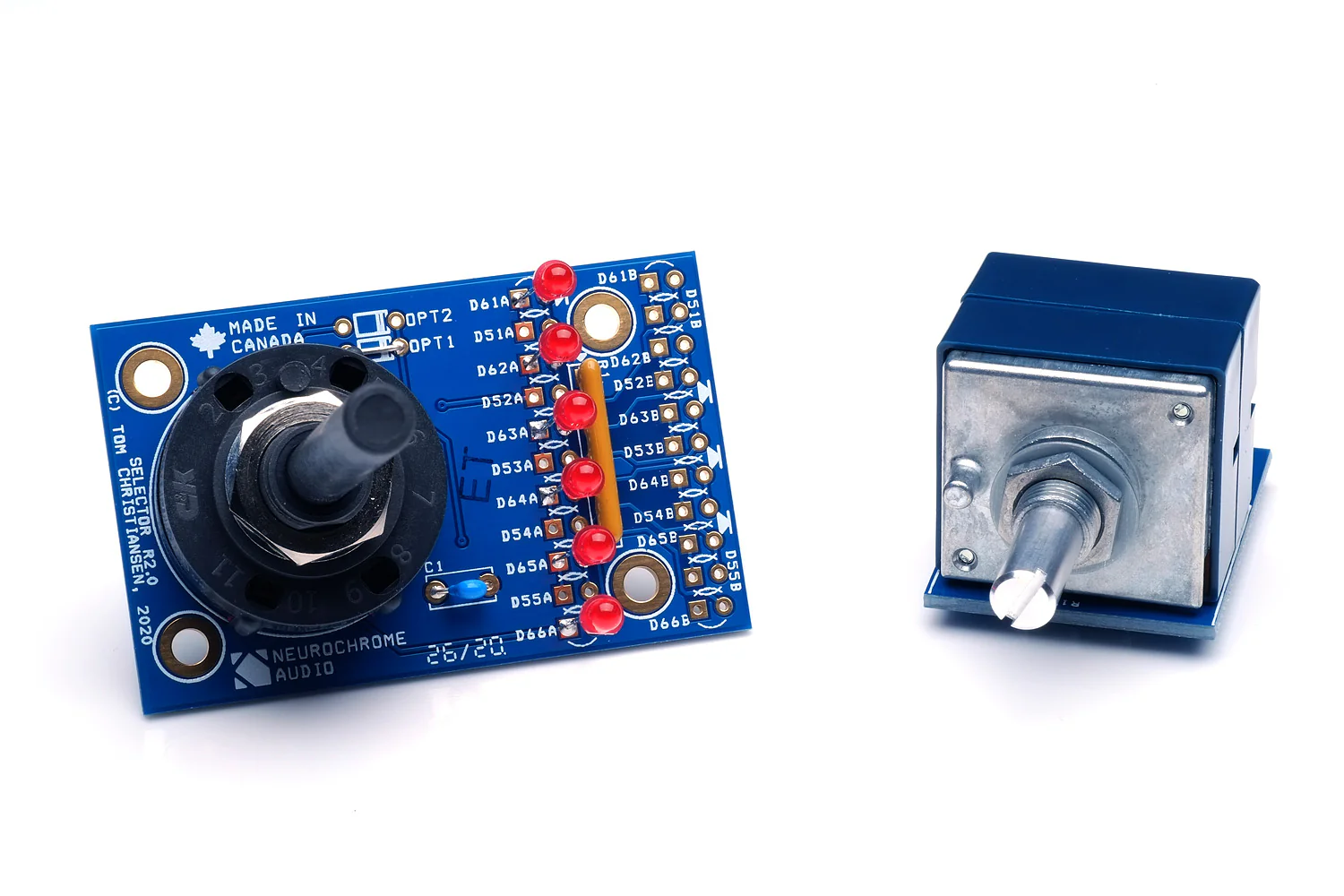
The Input Selector is a relay-based input selector which supports the selection of one of six stereo inputs. It can be used as a passive preamp by adding a volume control, such as the Selector Switch & Volume Control. An active preamp, or a preamp with gain, can easily be implemented by adding the Universal Buffer. This will result in a preamp with six stereo inputs and both balanced and unbalanced outputs. Balanced inputs can be implemented with the Universal Buffer as well.
The control input to the Input Selector is compatible with 3.3 – 5.0 V CMOS and TTL logic levels. This makes the Input Selector easy to interface to the many popular micro controller circuits, such as the Arduino.
The 45 × 112 mm gold-plated PCB is made in Canada.
Technical Documentation
- Features
- Specifications
- Performance Graphs
-
The features of the Input Selector are listed below.
- Relay-based input selector with six stereo inputs.
- High channel separation and excellent off attenuation.
- On-board 5 V regulator powers the relays.
- Relay Saver technology reduces the power dissipated in the relay coils by 36 % once the relay has switched, thereby enhancing the reliability and longevity of the circuit.
- Gold plated relays, designed specifically for small-signal use.
- Connection to volume control by 10-pin, gold-plated connector.
- 3.3 – 5.0 V compatible logic control inputs with ESD protection for audio input selection.
- Gold plated PCB. Made in Canada. The circuit module arrives fully assembled and ready to go.
-
The specifications of the Input Selector are tabulated below.
Note 1: The input impedance of a passive preamp is equal to the resistance of the volume pot. The maximum output impedance of such a preamp is equal to one quarter of the resistance of the volume pot.Parameter Value Notes Number of Stereo Inputs 6 Power Supply Voltage 6.0 – 25 V Power Supply Current 17 mA Input Impedance
10 kΩ
With recommended volume pot.
(Note 1)
Max. Output Impedance
2.5 kΩ
With recommended volume pot.
(Note 1)
Channel Separation 113 dB 1 kHz, incl. volume control Off Attenuation > 127 dB 1 kHz, incl. volume control Dimensions 45 × 112 × 14 mm Weight 46 g
-
The amplitude response and gain flatness of the input selector is shown below. As you would expect from a passive preamp, the gain is completely flat and slightly below unity due to the load of the volume pot on the signal source. The bandwidth of the Input Selector exceeds 200 kHz.


More importantly, the left-to-right channel separation is very high as shown below.

In addition to providing good separation between left and right channel, the Input Selector must also have good isolation between inputs. Otherwise the signal from an unselected source can leak through to the output. The measurement below shows the attenuation between an unselected channel and the selected channel, otherwise known as the off-attenuation. This attenuation is very high, which results in no bleed-through between signal sources.

Original: $130.00
-70%$130.00
$39.00Product Information
Product Information
Shipping & Returns
Shipping & Returns
Description
Inventory Reduction Sale: The Input Selector is on sale while supplies last.
The Input Selector is a relay-based input selector which supports the selection of one of six stereo inputs. It can be used as a passive preamp by adding a volume control, such as the Selector Switch & Volume Control. An active preamp, or a preamp with gain, can easily be implemented by adding the Universal Buffer. This will result in a preamp with six stereo inputs and both balanced and unbalanced outputs. Balanced inputs can be implemented with the Universal Buffer as well.
The control input to the Input Selector is compatible with 3.3 – 5.0 V CMOS and TTL logic levels. This makes the Input Selector easy to interface to the many popular micro controller circuits, such as the Arduino.
The 45 × 112 mm gold-plated PCB is made in Canada.
Technical Documentation
- Features
- Specifications
- Performance Graphs
-
The features of the Input Selector are listed below.
- Relay-based input selector with six stereo inputs.
- High channel separation and excellent off attenuation.
- On-board 5 V regulator powers the relays.
- Relay Saver technology reduces the power dissipated in the relay coils by 36 % once the relay has switched, thereby enhancing the reliability and longevity of the circuit.
- Gold plated relays, designed specifically for small-signal use.
- Connection to volume control by 10-pin, gold-plated connector.
- 3.3 – 5.0 V compatible logic control inputs with ESD protection for audio input selection.
- Gold plated PCB. Made in Canada. The circuit module arrives fully assembled and ready to go.
-
The specifications of the Input Selector are tabulated below.
Note 1: The input impedance of a passive preamp is equal to the resistance of the volume pot. The maximum output impedance of such a preamp is equal to one quarter of the resistance of the volume pot.Parameter Value Notes Number of Stereo Inputs 6 Power Supply Voltage 6.0 – 25 V Power Supply Current 17 mA Input Impedance
10 kΩ
With recommended volume pot.
(Note 1)
Max. Output Impedance
2.5 kΩ
With recommended volume pot.
(Note 1)
Channel Separation 113 dB 1 kHz, incl. volume control Off Attenuation > 127 dB 1 kHz, incl. volume control Dimensions 45 × 112 × 14 mm Weight 46 g
-
The amplitude response and gain flatness of the input selector is shown below. As you would expect from a passive preamp, the gain is completely flat and slightly below unity due to the load of the volume pot on the signal source. The bandwidth of the Input Selector exceeds 200 kHz.
More importantly, the left-to-right channel separation is very high as shown below.
In addition to providing good separation between left and right channel, the Input Selector must also have good isolation between inputs. Otherwise the signal from an unselected source can leak through to the output. The measurement below shows the attenuation between an unselected channel and the selected channel, otherwise known as the off-attenuation. This attenuation is very high, which results in no bleed-through between signal sources.